
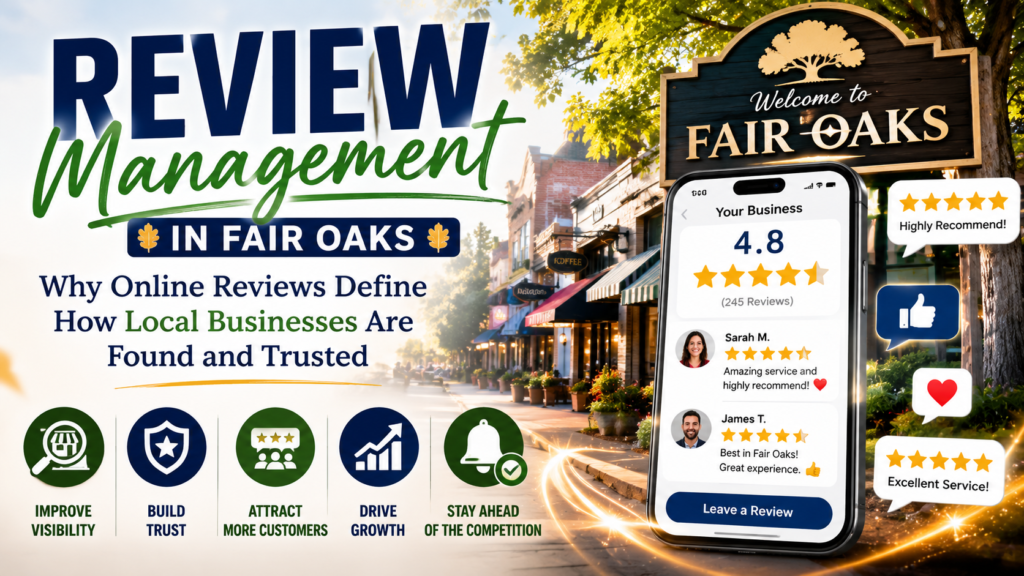
For any business operating in Fair Oaks, California, online reviews have become one of the most powerful factors determining whether a potential customer picks up the phone or scrolls past. In a community where word of mouth has always carried weight and neighbors actively share recommendations through local Facebook groups, Nextdoor, and community platforms, the digital version of that social trust, the online review, is now a foundational business asset. Understanding how Review Management Fair Oaks works and why it matters is essential for any local business that wants to grow and be found.
What Review Management Actually Is
Review management is the process of actively monitoring, responding to, and cultivating online reviews across the platforms where customers share their experiences. It goes beyond simply hoping for positive reviews or responding to complaints. A well-executed review management strategy includes a systematic approach to generating new reviews from satisfied customers, monitoring all platforms where the business may be discussed, responding to reviews in ways that reflect the business’s values, and using the feedback to improve service delivery.
The platforms most relevant to businesses in Fair Oaks include Google Business Profile, Yelp, Facebook, and Nextdoor. Each platform attracts a different segment of the local consumer audience, and each carries different weight depending on the type of business and the search behavior of its customers.
Why Reviews Matter More Than Most Business Owners Realize
The statistics around consumer behavior and online reviews are consistent and compelling. Research consistently finds that the vast majority of consumers, often cited at 75 percent or more, read online reviews before engaging with a local business. For service-based businesses in particular, where trust and reliability are central concerns, reviews are the primary mechanism through which that trust is established before any direct contact occurs.
In Fair Oaks, a community characterized by tight-knit neighborhood connections and a preference for local businesses, the reputation conveyed through online reviews functions as digital word of mouth, visible to anyone searching for a service at any time of day or night. A business with a strong review profile is essentially receiving ongoing endorsements from past customers around the clock.
How Reviews Influence Local Search Rankings
One aspect of review management that is often overlooked by business owners is its direct effect on local search visibility. Google’s algorithm for determining which businesses appear in the local map pack, those prominent map results that appear near the top of search results for queries like ‘paving contractor near me’ or ‘asphalt company Fair Oaks,’ takes review signals into account. These signals include review volume, overall star rating, recency of reviews, and whether the business owner responds to reviews.
A business that consistently earns new reviews and responds to them signals to Google that it is an active, reputable, and customer-engaged operation. This contributes to higher visibility in local search, which translates directly into more inquiries and more business.
Responding to Reviews: The Underestimated Opportunity
Many businesses in Fair Oaks collect reviews passively, allowing them to accumulate without engaging with them. This is a missed opportunity. Responding to reviews, both positive and negative, communicates important things about a business to anyone reading.
Responding to positive reviews acknowledges the customer, reinforces the relationship, and demonstrates that the business values its clients. Responding thoughtfully to negative reviews is even more powerful. Research shows that consumers reading a business’s response to a negative review form an impression not just of how the business handles complaints, but of its overall professionalism and character. A measured, solution-oriented response to a critical review can actually build trust with prospective customers who observe how the business conducts itself under pressure.
Generating Reviews Systematically
Many businesses rely entirely on spontaneous reviews, receiving them only when customers feel strongly enough, positively or negatively, to take the time to write one. The problem with this passive approach is that negative experiences are more likely to motivate unsolicited reviews than positive ones. Active review management involves building a systematic process for asking satisfied customers to share their experiences at the right moment.
The timing and method of the request matter significantly. Asking immediately after a completed job, when the customer is most satisfied and the experience is fresh, produces higher response rates than requests sent days later. Automated systems that send a polite follow-up message with a direct link to the review platform remove friction from the process, making it easy for even time-pressed customers to leave a review.
The Fair Oaks Context: Community Trust and Local Competition
Fair Oaks is a community where local businesses compete within a defined geographic market. When a property owner in Fair Oaks is searching for a contractor, they are typically comparing several options, and review profiles are often the deciding factor before a first phone call is made. Businesses with ten or fifteen reviews are often passed over in favor of those with fifty or a hundred, because a larger review base is perceived as more reliable evidence of consistent performance.
Local groups on Nextdoor and Facebook amplify this dynamic. When a neighbor asks for a contractor recommendation in a Fair Oaks community group, the businesses that are mentioned are typically those with strong reputations, and the online review profile backs up those personal recommendations when other group members look them up.
Monitoring Reviews Across All Platforms
A common mistake is monitoring only the most prominent platform, typically Google, while neglecting others. A negative review on Yelp or a complaint in a local Facebook group can influence prospective customers even if the business’s Google profile looks excellent. Comprehensive review management involves monitoring all platforms where the business may be discussed and setting up alerts so that reviews are seen promptly and can be responded to in a timely manner.
Conclusion: Reviews as a Business Asset
For any Fair Oaks business, particularly those in service industries where trust is paramount, reviews are not simply a reflection of past performance. They are a living, evolving asset that shapes future business. A well-managed review profile communicates credibility, demonstrates engagement, and actively contributes to local search visibility. Businesses that take review management seriously are building something that passive competitors are not: a compounding digital reputation that works for them every day.